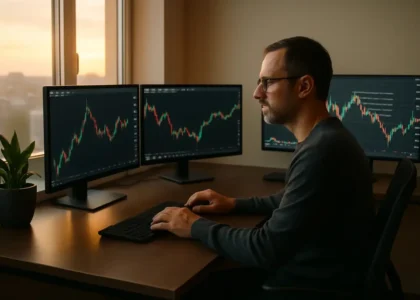

Trading is a world filled with opportunities, but also uncertainties. The allure of financial markets, especially volatile ones like gold (XAUUSD), is hard to resist, but it’s important to acknowledge that no matter how much preparation or analysis goes into a trade, outcomes are never guaranteed. For every calculated decision made, the market may respond in unexpected ways, and that’s what makes trading both exciting and challenging.
In this post, I’ll share my perspective on dealing with the uncertainty of trading and how traders can navigate this inevitable aspect of their journey.
When I first started trading, I believed that if I learned enough strategies, indicators, and market analysis techniques, I could accurately predict market movements. However, I quickly learned that the market doesn’t work that way. While having knowledge and skills is crucial, trading is not about predicting what will happen next; it’s about responding to what the market presents.
This realization made me understand that embracing uncertainty is part of being a trader. The market moves in patterns, but it also moves in ways that are influenced by countless variables beyond anyone’s control. It’s not about certainty; it’s about preparation and adaptability.
A common misconception is that confidence in trading comes from being sure of the outcome. However, true confidence comes from trusting your process, not the outcome. I remember the times I felt unsure of a trade’s result, but I had confidence in my strategy. I had back-tested my methods, understood the risk involved, and knew that even if the trade didn’t go my way, I was following my plan.
In trading, confidence is built by developing a strategy that aligns with your understanding of the market, testing it over time, and accepting that losses are part of the game. It’s not about being certain every trade will win; it’s about knowing that over time, with discipline, the strategy can work out in your favor.
The emotional aspect of trading is, in many ways, more challenging than the technical analysis itself. There are times when the market doesn’t go according to plan, and the uncertainty can bring anxiety, doubt, and fear. The moment when a trade starts to go against you, and you’re not sure what the outcome will be, is where emotions can cloud judgment.
One technique that has helped me is grounding myself by asking, “Have the conditions I based my trade on changed?” If the answer is no, then I remind myself to stay in the trade and stick to my rules. This simple question keeps me focused on the bigger picture rather than reacting emotionally to the market’s short-term movements.
I also remind myself that losses are inevitable and a natural part of trading. Even with a solid strategy, there will be losing trades. Accepting this fact has helped me develop emotional resilience and keep a clear head when dealing with uncertainty.
When the uncertainty of trading looms, it’s easy to get caught up in the desire for immediate results. However, one of the most valuable lessons I’ve learned is to focus on the process, not the outcome. If you have a strategy, stick to it, even when the market isn’t responding the way you anticipated.
For example, in my experience trading XAUUSD, there have been moments when my setup looked perfect, but the market didn’t follow through. In those instances, I remind myself that my job as a trader is not to control the outcome but to follow the process. If the setup meets my criteria, I take the trade, manage my risk, and accept whatever comes next. Over time, focusing on the process allows the probabilities to work in my favor.
A crucial aspect of dealing with uncertainty is understanding risk management. Since no one can be sure of the outcome, risk management serves as a trader’s safety net. Setting a predetermined risk level for each trade helps minimize potential losses and gives you the ability to stay in the market long enough for your strategy to prove itself.
I use a combination of stop losses and position sizing to ensure that no single trade can significantly damage my account. When I set up a trade, I’m not just thinking about the potential profit; I’m also planning for the worst-case scenario. This approach allows me to accept uncertainty, knowing that even if the market moves against me, I have controlled my risk.
The uncertainty of trading is not something to overcome but to accept. It’s a constant companion for traders, no matter how skilled or experienced. The key is to embrace the unknown and use it as a tool for growth. The unpredictability of the market forces traders to be humble, adaptable, and resilient.
Every trade is an opportunity to learn, not just about the market but about oneself. The uncertainty serves as a reminder that trading is a journey, not a destination. Instead of striving for a state where you’re always sure of the outcome, aim to become comfortable with the unpredictability and learn how to navigate it with confidence and discipline.
Trading is not about being right all the time; it’s about managing the inevitable uncertainty that comes with every decision. The phrase “I’m not just sure what the outcome will be” encapsulates the reality of every trader. However, by focusing on the process, managing risk, and building confidence in your strategy, you can approach each trade with the right mindset.
The beauty of trading lies in its unpredictability. It challenges us, tests our patience, and teaches us resilience. Embracing the uncertainty and finding confidence in the process rather than the outcome is the foundation of long-term success in trading.